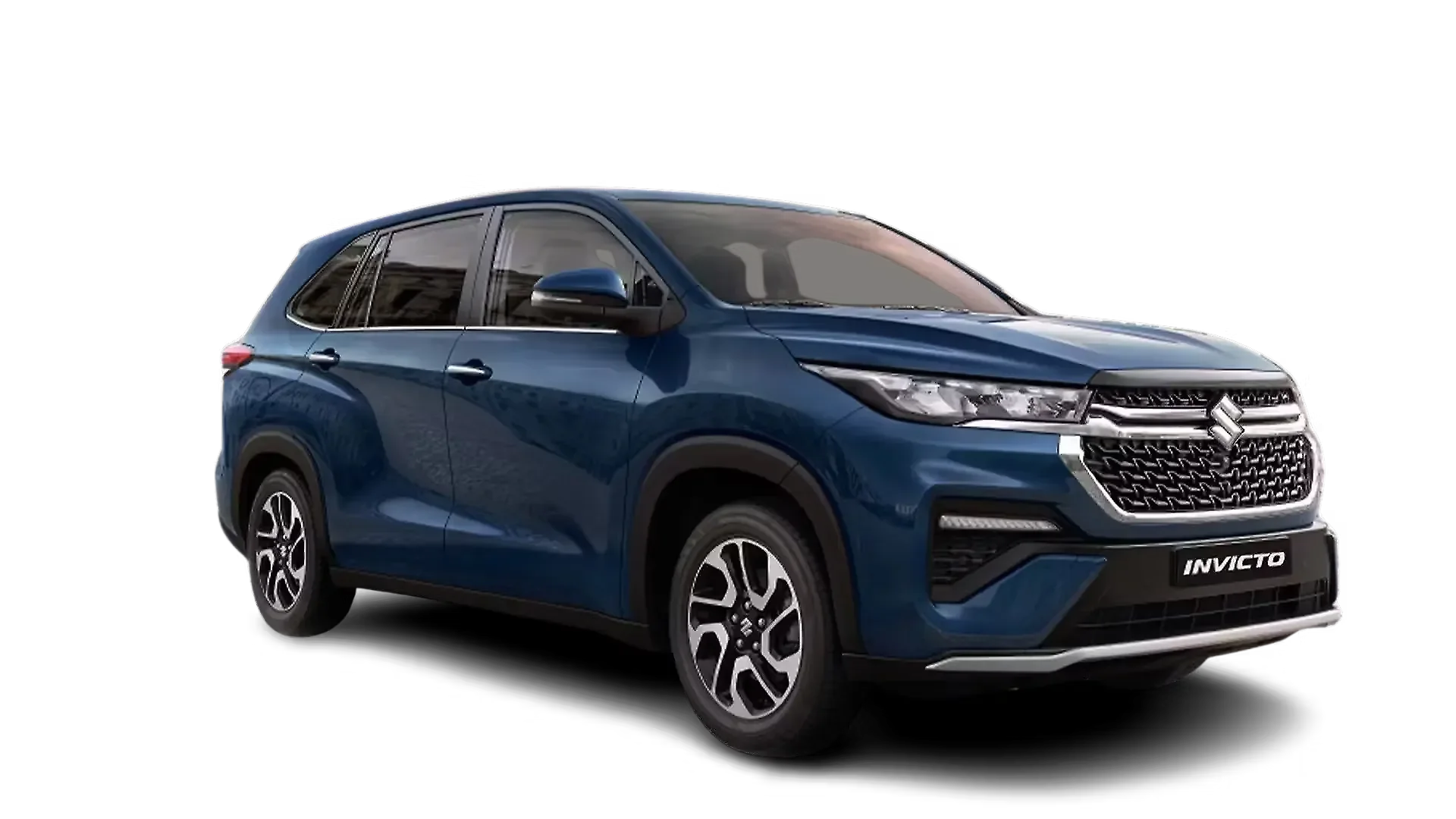
The Maruti Invicto is a rebadged Toyota Innova Hycross built in the same Karnataka plant, sold only as a strong-hybrid automatic through Nexa. It costs 24.79 to 28.42 lakh ex-showroom, undercutting the equivalent Hycross by about 1.4 lakh, but trades away ottoman seats, JBL audio, ADAS and 18-inch wheels.
Jury Score Breakdown
What Works
- Refined, near-silent EV crawl in city traffic with strong hybrid assist
- Genuine 17-20 km/l real-world fuel economy from a 7-seater MPV
- Spacious second row with reclining captain seats and dedicated rear AC
- Comfortable, well-damped ride on 17-inch wheels
- Faster delivery than Hycross and Nexa service network
Watch Out For
- No ADAS, no ottoman seats, no JBL audio versus the Hycross ZX(O)
- Cabin noise, engine drone under hard acceleration and weak brake feel
- Standard warranty of 2 years/40,000 km is shorter than Toyota's 3 years/1 lakh km
- Third-row headroom tight for 6-footers and average plastics in places
Design
The Invicto wears Nexa's three-block LED DRL signature, a twin-slat chrome grille and a redesigned bumper that drops the fog lamps found on the Hycross. The tail-lamp internals get the same three-element treatment, though the reverse lamp and indicators remain halogen. At nearly 4.8 metres long with a 2.9-metre wheelbase, it is unmistakably a full-size MPV. The biggest visual departure is the 17-inch alloy wheels wrapped in 215/60 R17 rubber, versus the Hycross top variant's 225/50 R18s. Faisal Khan argues the smaller wheels look slightly undertyred on a body this large, but they pay dividends in ride comfort. There is no hybrid badging and no variant lettering on the boot, keeping the rear cleaner than the Toyota.
Interior & Features
Inside, the Invicto swaps the Hycross's tan-and-black theme for an all-black cabin with rose-gold inserts on the dash, vents and doors, plus white double-stitching. It looks consistent and hides hard plastics better, though it feels less lavish than the Toyota at this price. The 10.1-inch touchscreen is the same Toyota unit: dated fonts, plain graphics, wireless Apple CarPlay but wired Android Auto, and a six-speaker setup that MotorBeam rightly calls below-average for a 30-lakh car. The 7-inch driver display lacks a tachometer. Captain seats replace the Hycross's ottoman chairs, are leather-wrapped, slide and recline manually, and offer limo-like legroom with rear AC vents, sunshades and two USB-C ports. Third-row adult headroom is tight above 5'10".
Build Quality & Technology
Because the Invicto rolls off the same Toyota line in Karnataka as the Hycross, panel gaps, door heft and switchgear feel are identical to the Toyota. Dashboard top is hard plastic but well-grained, the leather-wrapped steering and gear lever feel upmarket, and rose-gold inserts add visual interest. Feature highlights include a panoramic sunroof, ventilated front seats with eight-way power for the driver and two memory presets, electric parking brake with auto-hold, 360-degree camera, wireless charging as accessory, dual-zone climate, paddle shifters, and Suzuki Connect with 50-plus telematics features. The big omissions versus the Hycross ZX(O) are Toyota Safety Sense ADAS, ottoman second-row seats, nine-speaker JBL audio and 18-inch wheels. All Invicto variants do get six airbags as standard.
Performance & Powertrain
The sole powertrain is Toyota's 2.0-litre Atkinson-cycle petrol paired with a nickel-metal hydride battery and e-motor for a combined 184 bhp, driving the front wheels through an e-CVT. The engine alone makes 150 bhp at 6,000 rpm and 188 Nm from 4,400 to 5,200 rpm, while the motor adds 206 Nm from zero rpm. 0-100 km/h comes up in about 9.5 seconds. Around town the Invicto crawls silently on battery power, switching to petrol seamlessly; V3Cars and the Unknown Reviewer both note how electric-like the low-speed behaviour feels. Push hard and the engine drones loudly thanks to the CVT's rubber-band effect, and paddle shifters add little. Power tapers past 100 km/h but cruising at 100-120 km/h remains effortless.
Ride Quality & Handling
Ride quality is where the 17-inch wheels earn their keep. The taller sidewalls round off sharp edges that the Hycross's 18s thump through, and the suspension stays composed over broken Indian roads without floating. Body roll exists but is well contained for an MPV of this size, and the light, consistent electric steering self-centres properly, making the Invicto genuinely easy to place in city traffic. High-speed stability is decent rather than rock-solid, with some movement at triple-digit speeds. The bigger weaknesses are cabin insulation, which lets in road and tyre noise on coarse highways, and brake pedal feel, which needs more force than expected in emergencies. This is a chauffeur-friendly setup tuned for comfort, not corner-carving.
Price & Value
Pricing runs from 24.79 lakh for the Zeta+ 7-seater to 28.42 lakh for the Alpha+ 7-seater, ex-showroom, with the 8-seater Zeta+ costing 6,000 more. That undercuts the equivalent Innova Hycross by roughly 60,000 to 1.4 lakh depending on variant. For that saving you lose ADAS, ottoman seats, JBL audio and the larger wheels, but gain six standard airbags across the range and Nexa's sales experience. The catch is warranty: Maruti offers 2 years/40,000 km extendable to 4 years/80,000 km, against Toyota's 3 years/1 lakh km extendable to 5 years/2.2 lakh km. Resale will likely favour the Innova badge too. Value-conscious buyers may prefer the Hycross VX hybrid; those wanting the top-spec experience should still stretch to the Hycross ZX(O).
What India's Reviewers Agree On
Consensus
- Mechanically identical to the Toyota Innova Hycross, built in the same Toyota plant
- Strong-hybrid 2.0L petrol returns 17-20 km/l in real-world driving, claimed 23.24 km/l
- 17-inch wheels with higher-profile tyres deliver a plusher ride than the Hycross
- Cabin feels more sober than special at this price; infotainment and audio are weak links
- Shorter waiting period and Nexa dealer experience are the real reasons to pick this over the Hycross
Points of Disagreement
- Whether saving 1.4 lakh is worth losing ADAS, ottoman seats and JBL audio versus the Hycross
- Whether the all-black cabin feels appropriately premium for a 30-lakh MPV or too plain
Individual Reviewer Verdicts
"Original Innova Hycross makes more sense for features, warranty and resale, but Nexa service and faster delivery are real wins."
"Same Toyota-built car with three sensibly priced variants; buy it if Nexa is closer or you cannot wait for the Hycross."
"Alpha+ justifies its 3.63 lakh premium over Zeta+; pure value buyers should pick the Hycross VX hybrid instead."
"Maruti smartly made six airbags standard across the range, trading JBL audio and ADAS for better baseline safety."
"A rebadged Hycross with the same 2.0L hybrid, 23 km/l claim and 8-year battery warranty, sold only via Nexa."
"Strong-hybrid powertrain and comfortable ride make it a credible Innova alternative for buyers prioritising Maruti's network."