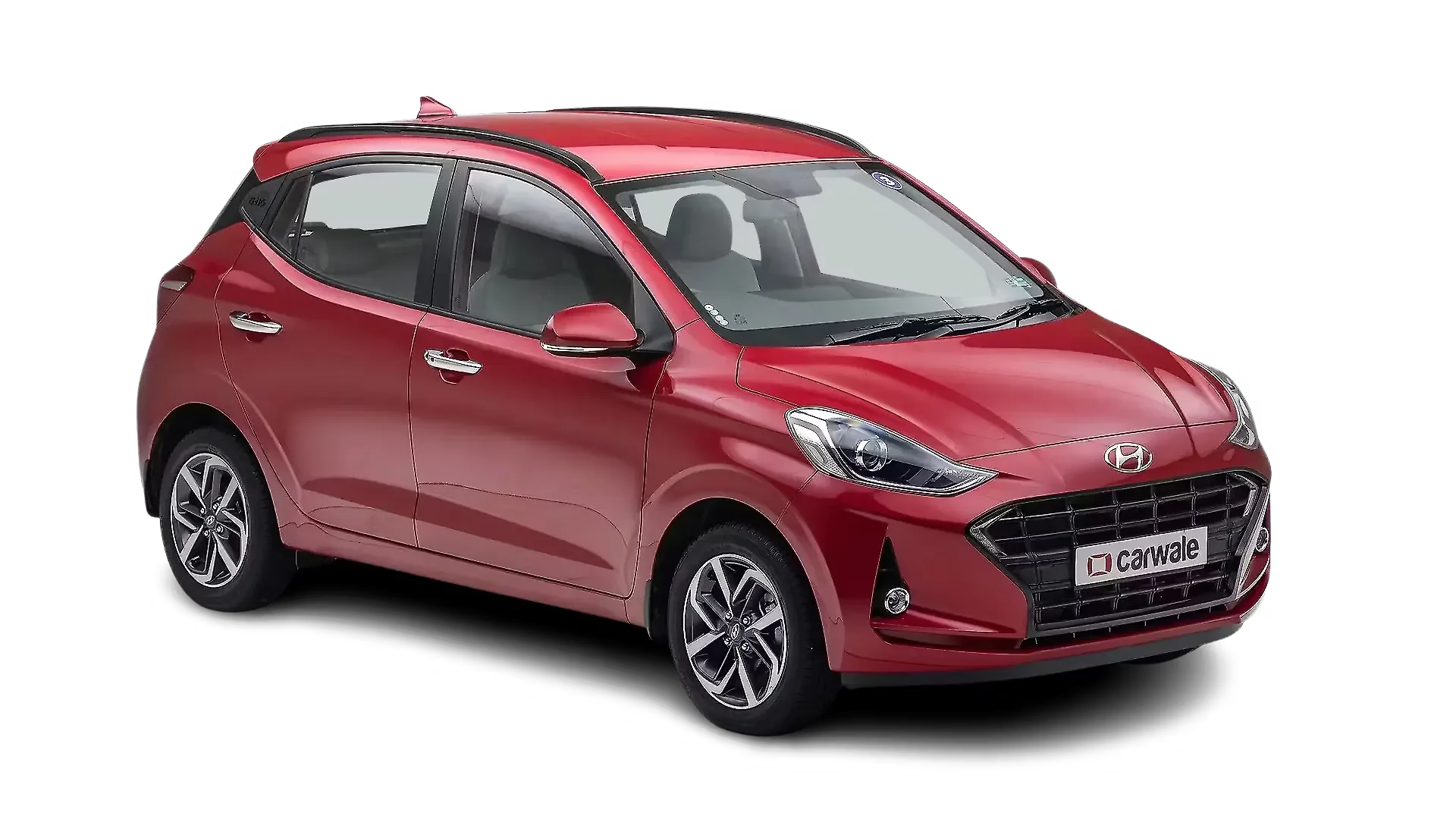
 Image: Hyundai press kit
A sensibly updated, feature-rich and reliable hatchback that remains a safe Hyundai bet, though sharper pricing would help.
The 2023 Hyundai Grand i10 Nios gets a mild cosmetic refresh, six airbags on top, cruise control, TPMS, a Type-C port and a connected-look LED tail lamp signature. The familiar 1.2-litre petrol with 5-speed manual or AMT, plus a CNG option, remains the heart of the range. Prices have crept up to Rs 5.68 lakh to Rs 8.47 lakh ex-showroom, which slightly dents the value case but doesn't break it.
The 2023 update is deliberately minimal. Up front, the bumper is reworked with a wider trapezoidal grille in gloss-black honeycomb, a body-coloured frame around redesigned LED DRLs and the fog lamps deleted. The halogen projector headlamps and bulb turn indicators are carried over unchanged, which feels dated at this price. The 15-inch alloys get a new motion-look design, but Hyundai has cost-cut lower trims: alloys are gone in mid variants, and the base car loses even wheel covers. At the rear, a connected-look LED tail lamp signature (the connecting strip is reflective, not lit) and a re-profiled bumper are the main changes. As AutoYogi notes, the updates are minimalistic but the car looks neater for it.
Inside, the cabin gets a dual-tone dark-grey and light-grey treatment with a new fabric-and-leatherette seat texture that lifts perceived quality without changing the dashboard architecture. The 8-inch touchscreen with wired Android Auto and Apple CarPlay carries over, flanked by physical shortcut keys and a proper automatic climate panel. The big additions are a wireless charger that actually charges quickly, a Type-C port alongside the USB-A, footwell lighting, a cooled glovebox on top and a redesigned instrument cluster with tachometer plus TPMS readout. A day-night IRVM is missing on the base variant, and there is no rear AC vent or rear armrest. Rear knee room and thigh support remain among the better efforts in the segment for adults up to around 5'8".
Build quality is one of the Nios's strongest cards. Panel gaps, switchgear action and plastic graining remain consistent with what Hyundai delivers a class above, and suspension components stay rattle-free over long ownership. Safety has been meaningfully addressed: four airbags are now standard, the top variant gets six, ESC and hill-hold are added, TPMS is included, and Hyundai claims unspecified structural reinforcement. Whether that lifts the car beyond its earlier two-star Global NCAP rating is unconfirmed. The dual-horn lock chirp is now quieter and can be muted entirely, automatic headlamps and a battery saver are standard, and a burglar alarm with immobiliser is fitted. The absence of a day-night IRVM on the base trim remains a curious omission.
The 1.2-litre four-cylinder petrol carries on with 83 PS and 114 Nm, now E20-compatible, paired with a 5-speed manual or AMT. The CNG option drops output to roughly 68 PS and 95 Nm. This remains, as V3Cars points out, a fundamentally city-friendly powertrain: light clutch, short-throw gearbox, tractable from 1500 rpm and smooth past the typical commute. It is not quick, and enthusiasts will miss the discontinued 1.0 turbo which MotorBeam rates as a genuine pocket rocket with 100 PS, 172 Nm and proper torque surge from 1700 rpm. Expect a real-world 17-19 km/l on the highway and 12-14 km/l in city traffic. The AMT exists for convenience buyers; the manual is the one to have.
Ride and handling sit in the comfortable-commuter zone rather than the engaging-hatchback one. The suspension tune feels marginally retuned: high-speed stability is genuinely better and sharp expansion joints are absorbed more confidently than before, but the Maruti Swift and Tata Tiago still soak up broken tarmac more cleanly. The biggest dynamic change is the steering. Hyundai claims structural reinforcement, and the wheel now feels noticeably heavier at parking and city speeds without delivering richer feedback, which some will read as solidity and others as artificial weight. At 70-80 km/h the weighting feels natural and the car tracks straight. The 175-section tyres are adequate for commuting but give up quickly if pushed.
Pricing now spans Rs 5.68 lakh to Rs 8.47 lakh ex-showroom, with variant-on-variant increases of roughly Rs 14,000 to Rs 40,000 over the pre-update car. That is justifiable given the added safety kit and features, but the top Asta touching Rs 8.47 lakh starts to look stretched against the Swift and Tiago, and even against Hyundai's own i20 mid-variants. The sedan sibling, the Aura, looks slightly better value in SX trim and offers CNG. As Gagan Choudhary observes, Hyundai dealers typically negotiate hard once stock builds, so on-road deals will likely soften the sticker shock. Standard four airbags, six on top, and Hyundai's service network keep the long-term ownership equation sensible.
"Best-selling variant remains a sensible all-rounder with top-class usability and a high-stance commuter advantage."
"Feature updates push the Nios close to i20 territory, but artificially heavy city steering is a step backwards."
"A well-equipped, safety-improved hatchback with petrol and CNG options, but only a two-star Global NCAP legacy."
"E20-ready 1.2 petrol stays peppy, returns around 20 km/l on relaxed runs and remains a fundamentally city-friendly car."
"The discontinued 1.0 turbo was the enthusiast pick; the regular Nios is a competent commuter, not a driver's hatch."