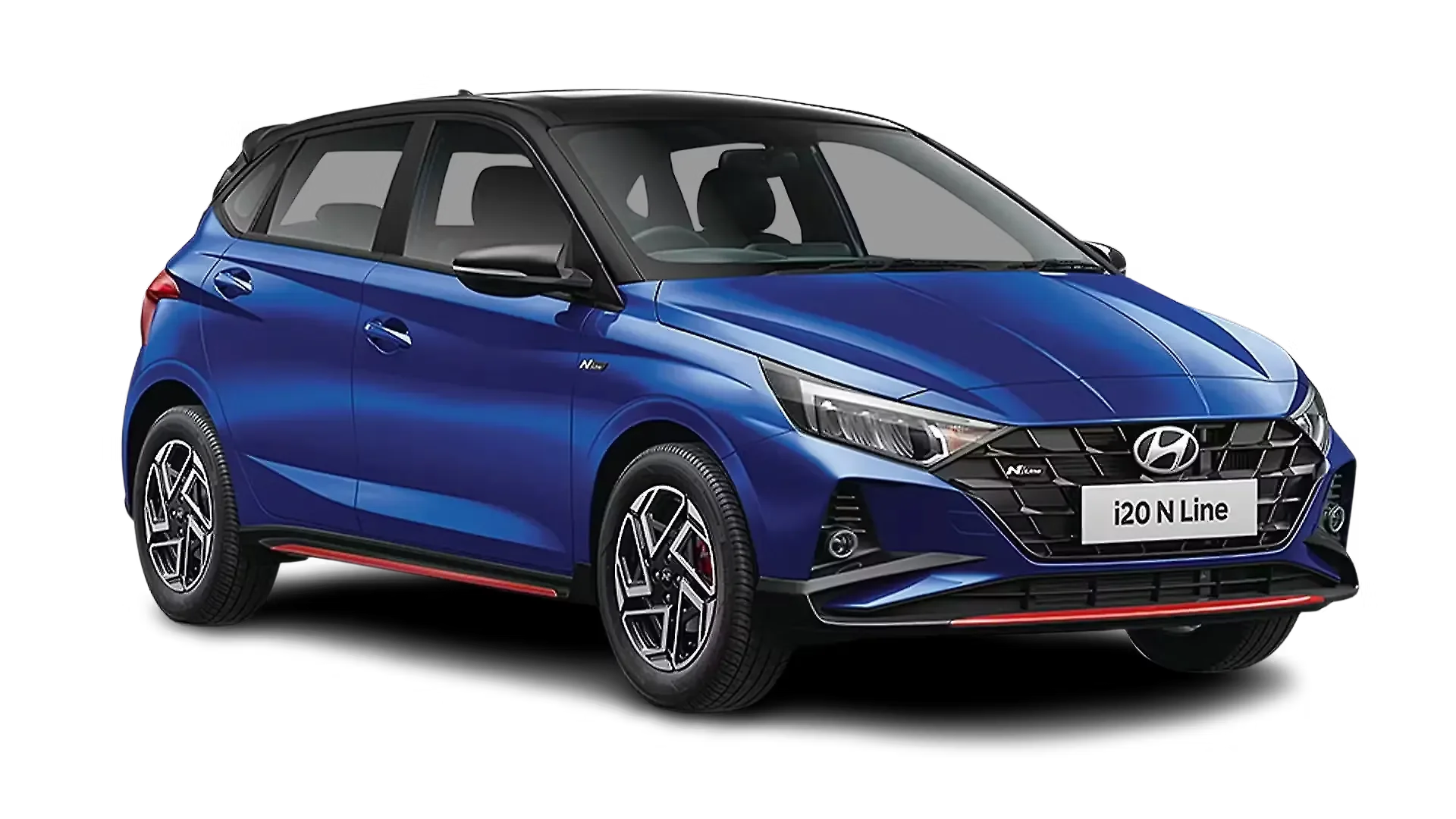
 Image: Hyundai press kit
A genuinely fun, well-equipped sporty hatchback that justifies its premium over the regular i20 for enthusiasts, provided you can live with stiff ride and no manual gearbox.
The Hyundai i20 N Line is the closest thing India gets to an enthusiast hatchback in 2024, blending sharper handling, sportier styling and a twin-tip exhaust note with the regular i20's practicality and features. It is not a power upgrade, but a chassis and character upgrade, and for roughly Rs 50,000-57,000 over the standard car, it offers a meaningful jump in driving engagement.
The i20 N Line wears its sportier intent convincingly. The checkered-flag grille, red lip in the front bumper, side skirts with red inserts, dark chrome rear strip, roof-integrated spoiler with side wings and twin-tip exhaust collectively give it a far more aggressive stance than the standard i20. The 16-inch diamond-cut alloys with red brake calipers up front add visual aggression without going overboard, and the Thunder Blue shade is exclusive to this trim. Faisal Khan notes the blue paint is hard to maintain in city use. Four colour options are offered including a dual-tone black-roof variant. The execution is restrained and tasteful: nothing looks tacked on, and it is one of the more genuinely sporty-looking hatchbacks on sale in India today.
Inside, the all-black cabin gets red ambient lighting, red stitching and piping on the leatherette seats, N Line badging on the seats, steering and gear lever, metal pedals and an electrochromic IRVM that the regular i20 misses. The flat-bottom three-spoke steering is lifted from the i20 N and feels excellent. The 10.25-inch touchscreen, fully digital cluster, Bose audio, wireless charging, sunroof and connected car tech are all present. However, the dashboard still uses a lot of hard, shiny black plastics that feel below par for the segment's most expensive hatchback, and the driver's seat sits a touch high even at its lowest setting, making the ideal driving position tricky for shorter drivers. Rear space is good by hatchback standards.
Build quality is typical Hyundai: solid where it shows, average where it does not. Doors shut with a reassuring thud and the painted surfaces are well finished, but the cabin uses too many hard, shiny black plastics for a car at this price point. The Namaste Car walkaround confirms 66% high-strength steel in the body shell. Safety kit is comprehensive: six airbags, ESC, hill-start assist, VSM, TPMS, rear camera and three-point belts all round are standard on the N8. The connected car tech via Bluelink offers 60-plus features. Faisal Khan reports no DCT or fuel-pump issues across 10,000 km of long-term running, suggesting the much-discussed early-batch niggles may have been resolved on current production cars.
The 1.0-litre turbo GDI petrol makes 120 PS and 172 Nm, identical to the regular i20, and is offered with a 6-speed IMT or 7-speed DCT; the manual has been dropped. The DCT claims 0-100 km/h in 9.9 seconds and includes paddle shifters. In practice, turbo lag and a hesitant DCT off the line blunt initial response, and getaways feel slower than the numbers suggest. Once on boost, the mid-range is strong and overtakes are effortless, with a sporty three-cylinder note audible around 3,000 rpm. The near-unanimous gripe, voiced clearly by MotorBeam, is the missing power bump: a performance badge without performance figures feels like a missed opportunity, especially given the Baleno RS and Punto Abarth precedent.
This is where the N Line earns its badge. Dampers are 30% stiffer, the steering is weightier and better centred, and the car tracks confidently at highway speeds with minimal body roll. Through corners it feels planted and genuinely engaging, though the stock 195/55 R16 tyres give up grip before the chassis does. The trade-off is ride quality: over broken surfaces the car crashes through sharp inputs, and Gagan Choudhary observes that low-speed bump absorption is actually slightly better than the regular i20 thanks to revised damping, while Faisal Khan reports the long-term experience can feel busy on bad roads. All-disc brakes deliver strong, progressive stopping power. For a daily-driven sporty hatchback in Indian conditions, the balance is acceptable rather than perfect.
Pricing runs from roughly Rs 9.99 lakh to Rs 12.5 lakh ex-showroom, with the top N8 DCT around Rs 14.57 lakh on-road. The N Line commands a Rs 50,000-57,000 premium over the equivalent regular i20, and most reviewers agree the cosmetic, dynamic and brake upgrades justify that delta comfortably. The bigger question is the i20's absolute pricing: it was already expensive before the N Line existed. Real-world fuel economy ranges from 6-6.5 km/l when driven hard to 12-16 km/l on the highway, with mixed-use figures of 13-15 km/l reported. For buyers cross-shopping the Fronx turbo or considering the discontinued diesel, the value equation is tighter, but for enthusiasts the N Line remains the most engaging hatchback at this price.
"After 10,000 km of long-term ownership, the N Line nails the sporty-plus-practical combo but desperately needs a manual gearbox option."
"A worthwhile pick for enthusiasts on a budget; everyone else will be just as happy with the regular i20."
"If you are already buying a 1.0 DCT or IMT i20, there is no reason to skip the N Line over the regular car."
"A comprehensively equipped sporty hatchback with strong safety kit, distinctive styling and class-leading feature count."
"The chassis and suspension changes are genuine engineering work, but a naturally aspirated 1.5 would have unlocked the platform's true potential."
"Driver-focused buyers planning a 1.0 DCT N8 should make the N Line their default choice over the regular i20."
"Tastefully executed performance variant let down only by the missing power bump; still the most enthusiast-friendly hatch on sale."