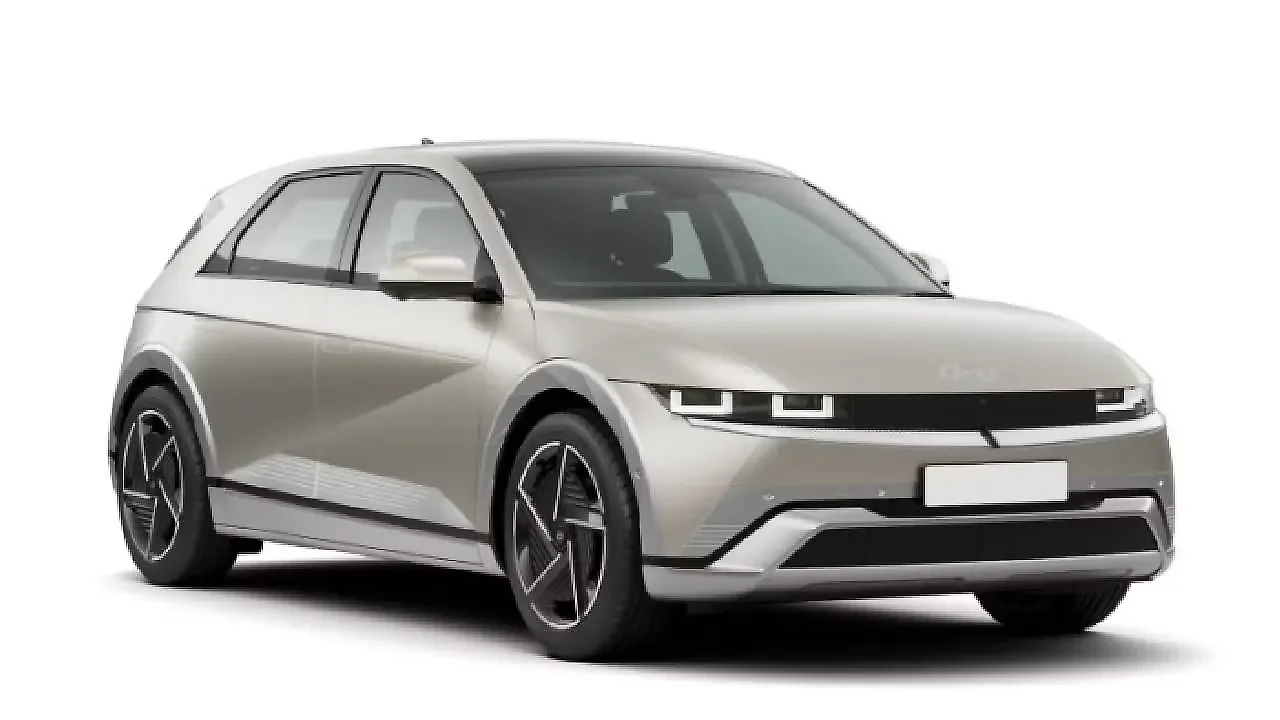
 Image: Hyundai press kit
A genuinely sorted, well-built premium EV with strong real-world range and Hyundai's reliability, though the 46 lakh price limits it to early adopters.
The Hyundai Ioniq 5 lands in India at Rs 45.95 lakh ex-showroom as a concept-car-looking electric crossover with a 77.4 kWh battery, ARAI-claimed 631 km range and a genuinely premium cabin. It is one of the most polished EVs on sale here, though buyers must weigh its price against luxury-brand alternatives and patchy public charging.
The Ioniq 5 wears one of the cleanest, most distinctive shapes on Indian roads. Pixel-pattern LED headlamps and tail-lamps, flush pop-out door handles, a three-metre wheelbase with stubby overhangs and 20-inch alloys give it a presence that reads as concept car rather than crossover. At 4,635 mm long it is closer in footprint to a Creta than a Tucson, yet the proportions make it look substantially larger. India gets the Vision Roof, a fixed panoramic glass panel that does not open but floods the cabin with light, and the matte exterior shades amplify the futuristic theme. There is nothing flashy or overstyled here; the surfacing is restrained and the detailing genuinely modern, which is why it draws stares without trying.
The cabin follows a flat-floor, lounge-like layout enabled by the E-GMP skateboard platform, with a sliding centre console that no other car in this price band offers. Twin 12.3-inch screens, sustainable materials, a Bose system and ambient lighting deliver the premium feel. India-spec additions are meaningful: front zero-gravity relaxation seats, ventilated front seats, electric rear-seat adjustment from the front, memory function and the Vision Roof are all standard here but optional or absent in some global markets. Rear knee room is generous though under-thigh support is average and the floor is high. The glaring miss, as Rohit notes, is the lack of wireless Apple CarPlay and Android Auto in a car this expensive, and rear seats are heated but not ventilated.
Panel gaps, switchgear weight and material choices feel a clear notch above mainstream Hyundai. Two months and 2,000 km in, V3Cars reports zero rattles, no software glitches and consistent behaviour. The car carries a 5-star safety rating, six airbags and the full Hyundai SmartSense Level-2 ADAS suite with 21 functions, though remote smart parking assist and parking collision-avoidance assist have been deleted for India. The 800V electrical architecture supports DC fast charging from 10-80% in 18 minutes on a 350 kW charger, and Hyundai bundles a 3.3 kW and an 11 kW home charger plus installation. Warranty stands at three years unlimited km, extendable to five years/160,000 km, with eight years/160,000 km on the battery and three years roadside assistance.
India gets the 77.4 kWh battery driving a single rear motor making 215 bhp and 350 Nm, good for 0-100 km/h in 7.6 seconds. Power delivery is the highlight: instant, refined, and so satisfying that V3Cars' Sahil admits the car has changed his throttle habits, with full-throttle squirts becoming a daily indulgence. The i-Pedal mode is the cleanest one-pedal implementation in India, bringing the car to a complete stop unlike Tata's crawling calibration, and four levels of regen adjustable via paddles let you tune deceleration to traffic. Adaptive cruise control is non-intrusive and the rear cross-traffic auto-brake has prevented incidents in real-world testing. The performance-focused Ioniq 5 N with 641 bhp and simulated gearshifts is not on sale in India.
The suspension is tuned soft and that pays off on Indian roads. Broken patches, expansion joints and mid-corner bumps are dispatched with a composure that belies the 20-inch wheels, and the 163 mm laden ground clearance, highest in Hyundai's India lineup, handles speed breakers without scraping. There is some float at higher speeds and mild body roll, but the steering carries a deliberate artificial weight that lends straight-line confidence even if precision is not its strength. High-speed stability at triple-digit cruising is solid, braking is strong and predictable, and the Michelin EV-specific tyres grip well. Adaptive cruise blends with auto-regen smoothly, making expressway running genuinely relaxed. This is a long-distance tourer first, corner-carver second.
At Rs 45.95 lakh ex-showroom the Ioniq 5 sits in awkward territory. It is meaningfully more expensive than the MG ZS EV and BYD Atto 3, yet undercuts entry luxury EVs like the BMW iX1 and Volvo XC40 Recharge. Gagan's read is the most honest: the car itself is worth the money given the design, build, features and real-world range, but the question is whether Indian buyers ready to spend 46 lakh on an EV will pick a Hyundai over a badge. Running costs are low at roughly Rs 3-4 per km on public fast charging and lower still with home charging, but V3Cars' Sahil makes a sharp point: it takes 1-5 lakh km to recover the EV premium, so buy it for the driving experience, not just the economics. Within Hyundai's own range, those wanting electric mobility cheaper should look at the Creta Electric.
"Car is perfect for 46 lakh, but uncertain how many luxury-segment buyers will pick a Hyundai badge."
"Real-world Mumbai-Pune round trip returned close to 500 km of range, beating his pessimistic 410 km estimate."
"After two months and 2,000 km, the driveability and instant response are the real reason to own one."
"The Ioniq 5 N is the most engaging EV he has driven, but is not sold in India."
"Comfortable, confidence-inspiring and feature-loaded, with a realistic 500 km range in mixed driving conditions."